
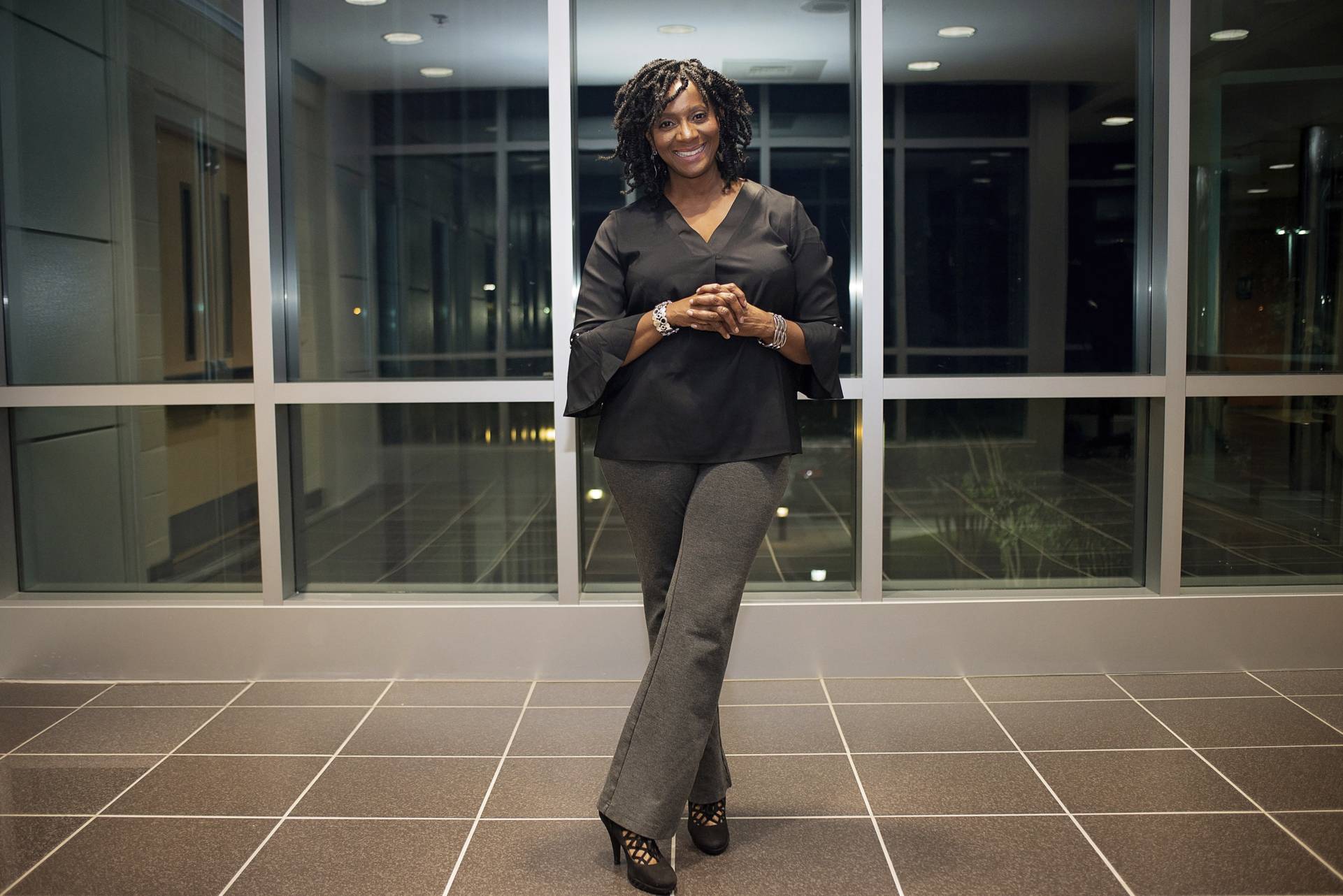
Sharing and Exploring
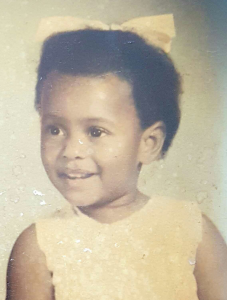
A star is born!
Since I can remember I have always had the need and passion to share information. From a young age growing up in the South communicating news about the local community, across town, the city next door, our state and the country always seemed important to me. Sometimes sharing certain information got me in trouble with my family when I was young, but I learned the difference between what internal sharing is and what can be shared externally quickly.
This passion for sharing developed into storytelling from performing the Easter speech at church to high school theatre and now I have built a career in theatre. I started as an actor, singer and dancer and eventually transitioned into choreography and directing.
The little girl who fell in love with sharing has explored this concept all her life and has found it to be more fulfilling than she ever imagined.
Donna's Perspective
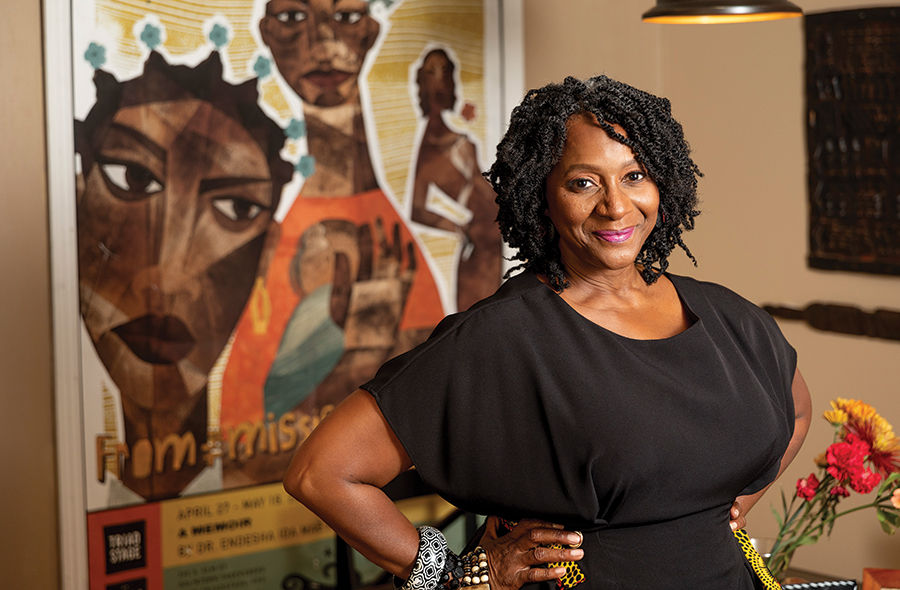
Donna Bradby’s theatre work is profoundly socially conscious, blending narrative, history, and performance to address themes of race, gender, justice, abuse, and human dignity. Her productions serve as platforms for cultural reflection and civic engagement, transforming theatre into a tool for social awareness, education, and change.
She is also known as a theatre artist who integrates a rich social commentary into her theatrical work, focusing on the human condition, and the lived experiences of marginalized communities. Her productions consistently tackle themes of sexuality, body image, family dynamics, and systemic inequality, often through the lens of personal narratives and historical context.
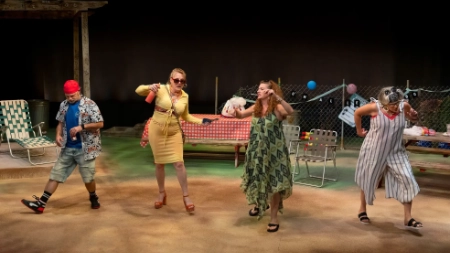
For example, in Barbecue, the interplay between a Black family and a white family exposes societal perceptions, cultural stereotypes, and the shared humanity beneath outward differences. Production serves as a satirical reflection on racial and family politics.
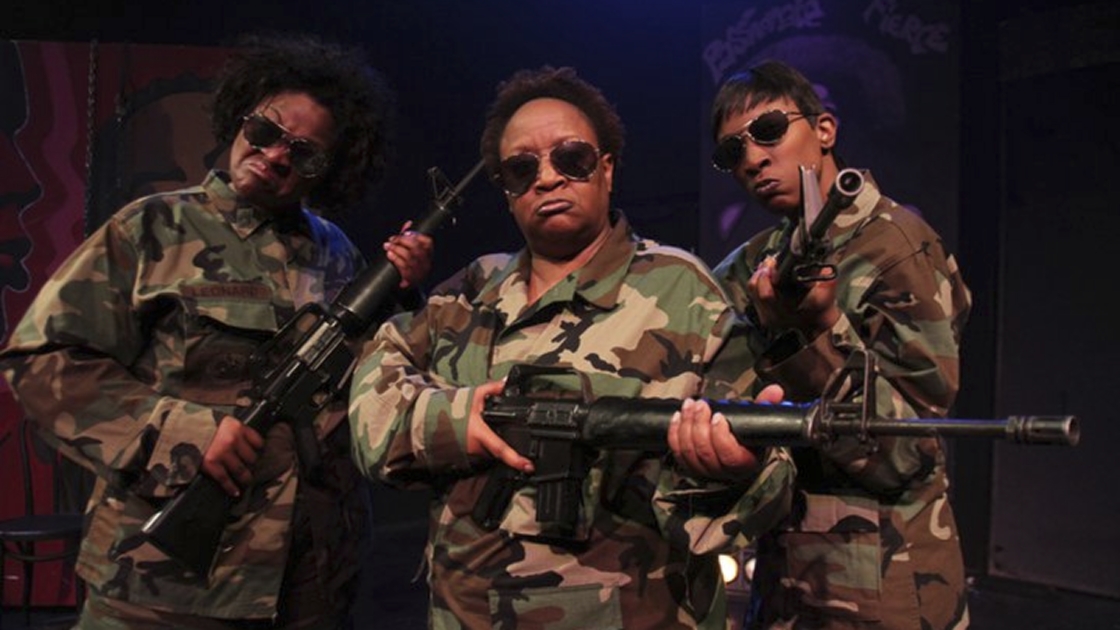
Her adaptation of Pearl Cleage’s Mad at Miles: A Black Woman’s Guide to Truth directly engages with themes of sexual abuse, #MeToo, and accountability in the music and entertainment industry. Bradby, drawing from her own experiences as a survivor of sexual abuse, addresses the emotional and psychological impact of violence against women, emphasizing the intersections of gender, artistry, and societal responsibility.
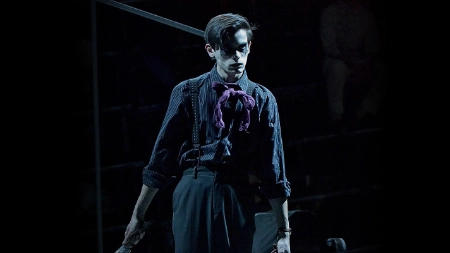
Bradby emphasizes theatre as a site for collective engagement and transformation. Shows like Violet and Ernest and the Pale Moon provoke dialogue on trauma, healing, and intergenerational understanding. She often collaborates with diverse casts and educational institutions to foster a sense of shared community and social empathy.
She believes that theatre should dissect and deconstruct the audience’s lived reality, sparking reflection and dialogue. She prioritizes authentic, relevant storytelling and often mentor’s students and interns to engage with arts as a medium for advocacy and empowerment.
Donna Bradby’s theatre is profoundly socially conscious, blending narrative, history, and performance to address themes of race, gender, justice, abuse, and human dignity. Her productions serve as platforms for cultural reflection and civic engagement, transforming theatre into a tool for social awareness, education, and change.
Aclaimed Works
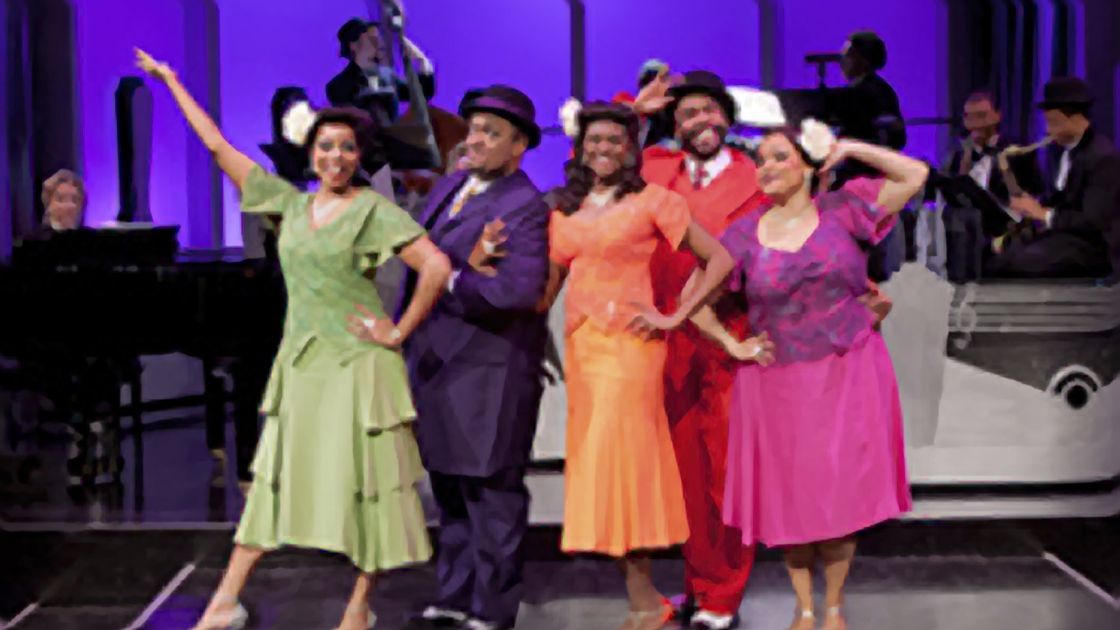
Ain't Misbehavin'
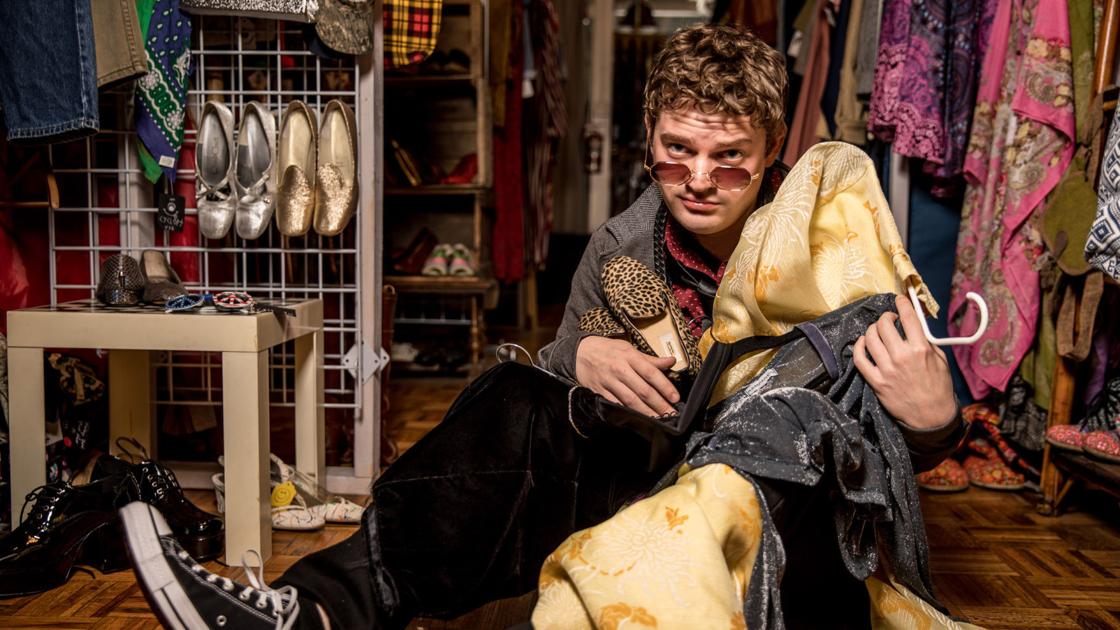
Buyer and Cellar
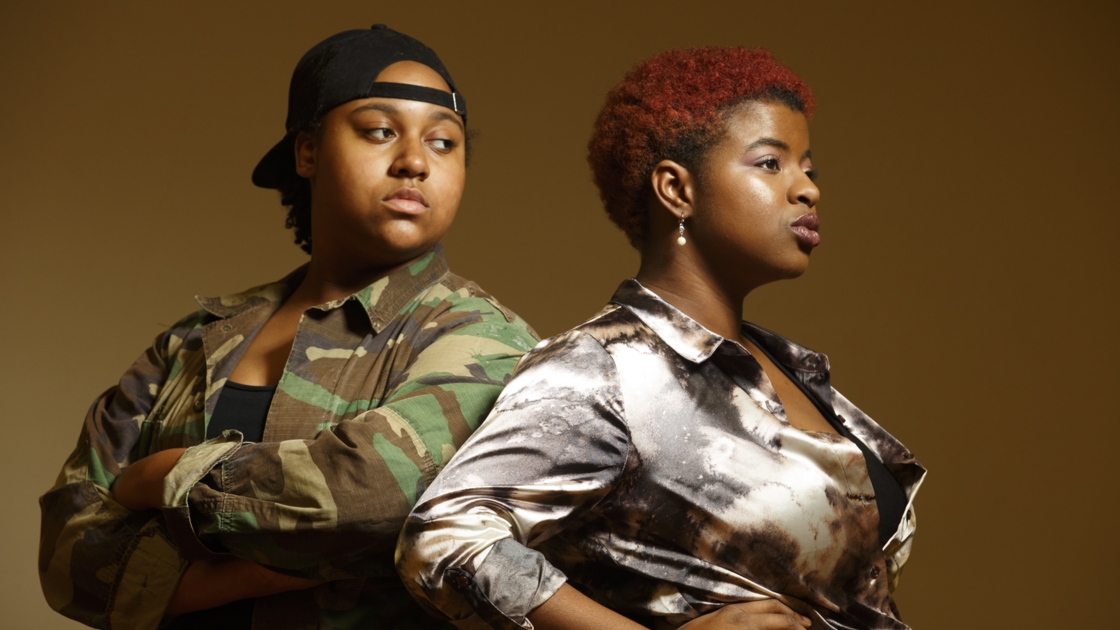
This ONe Girlks Story
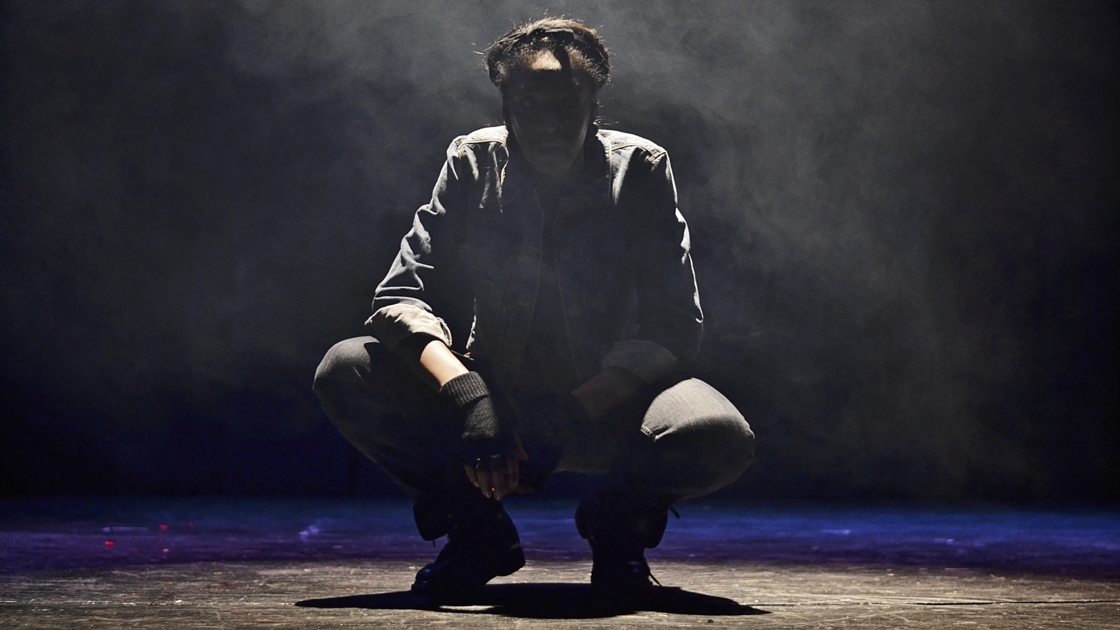
Breath Boom
Ethel Waters
Mad at Miles
Ernest and the Pale Moon
JaJa's African Hair Braiding
Barbeque
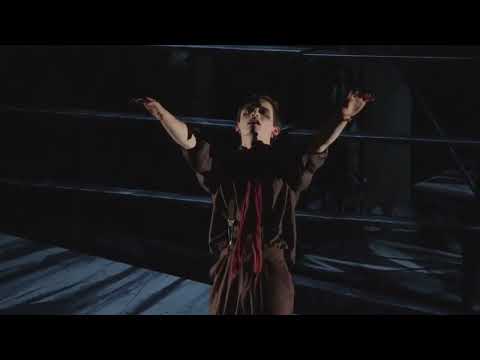
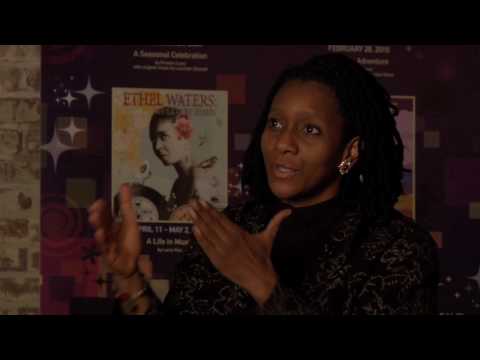
Videos
Reviews
Mad at Miles: A Black Woman's Guide To Truth
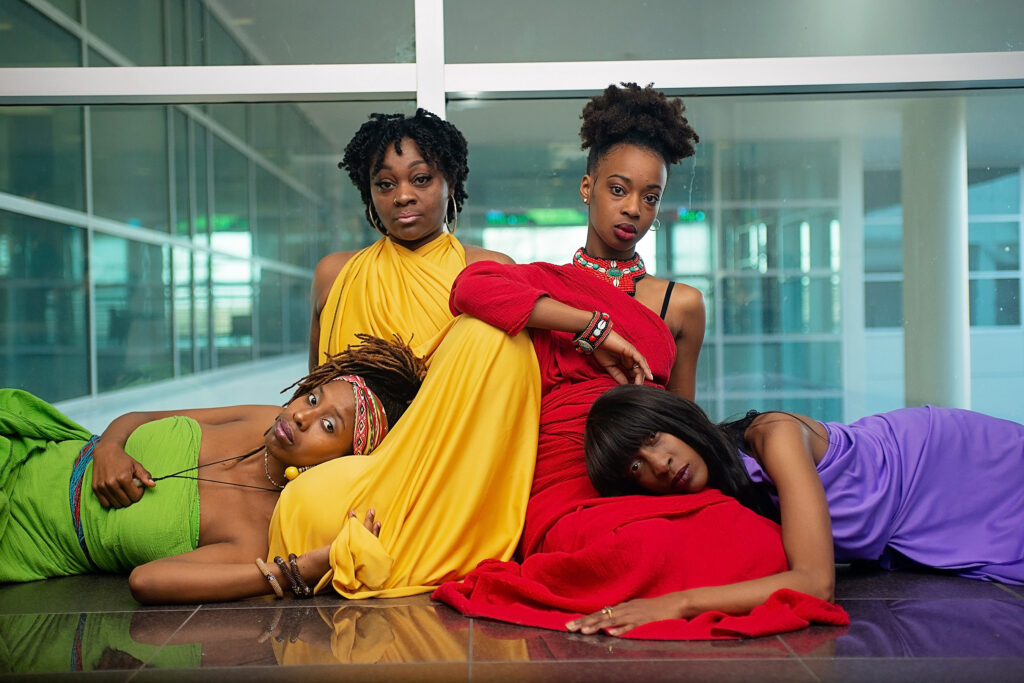
Mad at Miles: A Black Woman's Guide To Truth, Theatre Review
By: Molly McGinn
If you’re expecting a biography on the life of Miles Davis through the eyes of past lovers, forget it. What’s worse, “Mad at Miles” may make you flinch just a bit next time you reach for “Filles De Kilimanjaro” or “Kind of Blue.” You might even be tempted to scratch it.
The three-woman, one act play, “Mad at Miles” plays out more like its subtitle: “A Blackwoman’s Guide to Truth” in the UpStage Cabaret at Triad Stage. It makes the recent Blockbuster “He’s Just Not That Into You” look like a girl scout meeting.
No, “Mad at Miles” walks in stiletto combat boot heels all over that fine line between racism and sexism, genius men and the women who love them, and the stories that sting you awake to the brutal truth of domestic violence.
Recent headlines of love gone violently wrong make it impossible to dismiss as the least of America’s problems right now. On the same night a tearful Jennifer Hudson won her first Grammy, news headlines started to crawl about the alleged Rhianna and Chris Brown incident on the way to the Grammy event. And when those headlines are gone, there’s this one: Every day four women in America die from the hand of a lover.
And while love-turned-hate isn’t limited to genius lovers — such as the fatal shooting of Marvin Gaye by his father — “Mad at Miles” is a kind of a “Vagina Monologues” take on shocking women awake to the truth of domestic violence. And if the “v-word” makes you squirm, this might not be the right play for you.
The only reference to Davis was made when the three women retell a story from a Davis biography about the night he laughed with cops upstairs while girlfriend Cicely Tyson hid in the basement, slapped into silence after Davis hit her.
The play’s three characters wither and rise with vignettes like this, delivered in beat poet-inspired dialogue and wincing observations. More than once, I felt chills go through my legs and spine as playwright Pearl Cleage exposed a demagogue.
Directed by Donna Baldwin-Bradby, the play moves like a synchronized interpretive dance without ever interfering with the dialogue. A mix of recorded and live music, original artworks for a stage set, and performances ranging from explosive to tender from Tennille Foust, Jamila Curry, and TaNisha Shavonne Fordham made it impossible to look away.
There was, only one point, when I struggled over whether to listen to the dialogue or “So What” playing softly in the background.
Cleage’s hilarious commentary on the foibles and flaws of love kept it far from being a straight-up feminist festival. Whether domestic violence is your story or not, you’ll relate to something.
Like why we all — not just women — forgive genius of any kind, choosing instead to play a broken record of war, or business, or flawed leadership again, and again, hoping maybe this time, the rekkid don’t skip.
I mean come on. Just because he hit a woman, you can’t stay mad at Miles, right?
For a closer look at the set, check out Drew Barker’s blog, Inside Triad Stage.
Born Bad
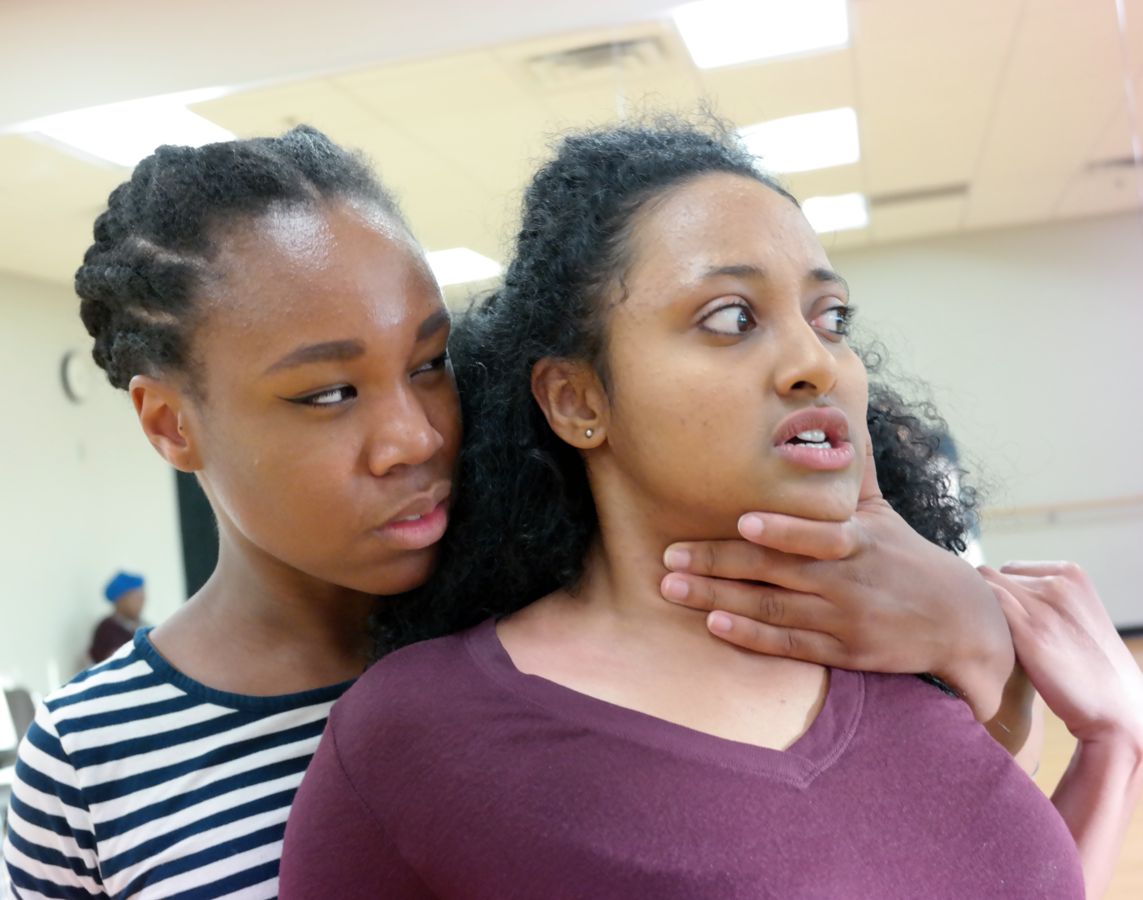
Born Bad theatre review
Winston-Salem Journal
By Bill Cissna, Special Corrospondant
In the bruising, sometimes baffling world of Debbie Tucker Green’s play “Born Bad,” it’s not easy to tell which end is up and who’s telling the truth — if indeed anyone knows the whole truth. It’s not a long play, but that may be in its favor. Emotions this powerful might not be survivable over an extended period of time.
Paper Lantern Theatre previewed “Born Bad” last night at the Mountcastle Forum, Rhodes Arts Center. People who don’t mind some serious with their theater should be lining up for the regular shows. This is a powerhouse production.
Very solidly directed by Donna Bradby, “Born Bad” drops in on a Caribbean-English family at a critical juncture. Literally inside a set designed by Daniel Alvarez, the eldest of four children has decided to finally confront her mother about her complicity with a long-held family secret.
The problem is, it’s far from the only secret — or denial — in this family of six. Though Alvarez’s set could be called an open box, the audience may realize over the play’s single act that it is more likely a very, very restrictive cage.
It’s also a dimly-lit cage most of the time, from lighting designer Adam Taylor, which is fitting for the dark, sad and angry conversations that take place within this space. When Dawta (a strong and believably-hurt Lalenja Harrington) levies her attacks at Mum (Sandra Jones, whose best moments come later in the show) after an opening rendition of “What a Friend We Have in Jesus,” it sets off a nuclear blast within the family.
Nearly the entirety of the play is a barrage of words, accusations, denials, counter-accusations and falsehoods. The middle sister (compellingly played by Melat Ayalew) floats in and out of revelations that she constantly counters with claims of insufficient memory. The youngest sister (a firebrand of denial — or is it true she doesn’t know — embodied by Jessica Smith) is not having any of these “stories” until the question marks begin to appear in her eyes.
The roles of Sister 1 and Sister 2 will also be played by Ebony Humes and Sha-Reh Reese, respectively. Into this mix comes Brother (Xavier Harris), who wobbles back and forth on making his own shattering revelation while Dawta at first disbelieves, then begs for his support.
The lurking presence is Father (Jp Pettiford), who is given very little to say, but when he does, it’s strikingly sad and shocking.
This family has so much wrong with it, it’s hard to know if they’ll ever get better, any of them. And though Mum has some words on the subject midway through, by the end, it’s very hard to tell who is actually “born bad” in this story. You should consider going and making up your own mind.
Jaja’s African Hair Braiding
Written by: Perry Tannenbaum
Original Article can be found at: https://qcnerve.com/jajas-african-hair-braiding/
My dear old Mom was born and raised in Harlem over a century ago, when a massive African-American cultural and literary Renaissance named for the fabled Manhattan district had already begun, with its storied 125th Street having been a major destination for northern migration after Lee surrendered to Grant. Even then, it would hardly be respectful to change Harlem’s name to Little Africa after all these years.
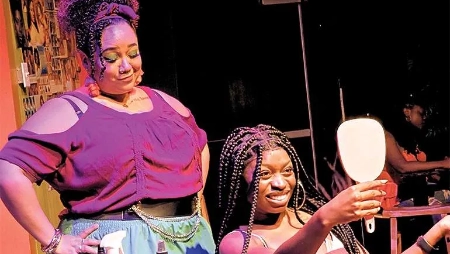
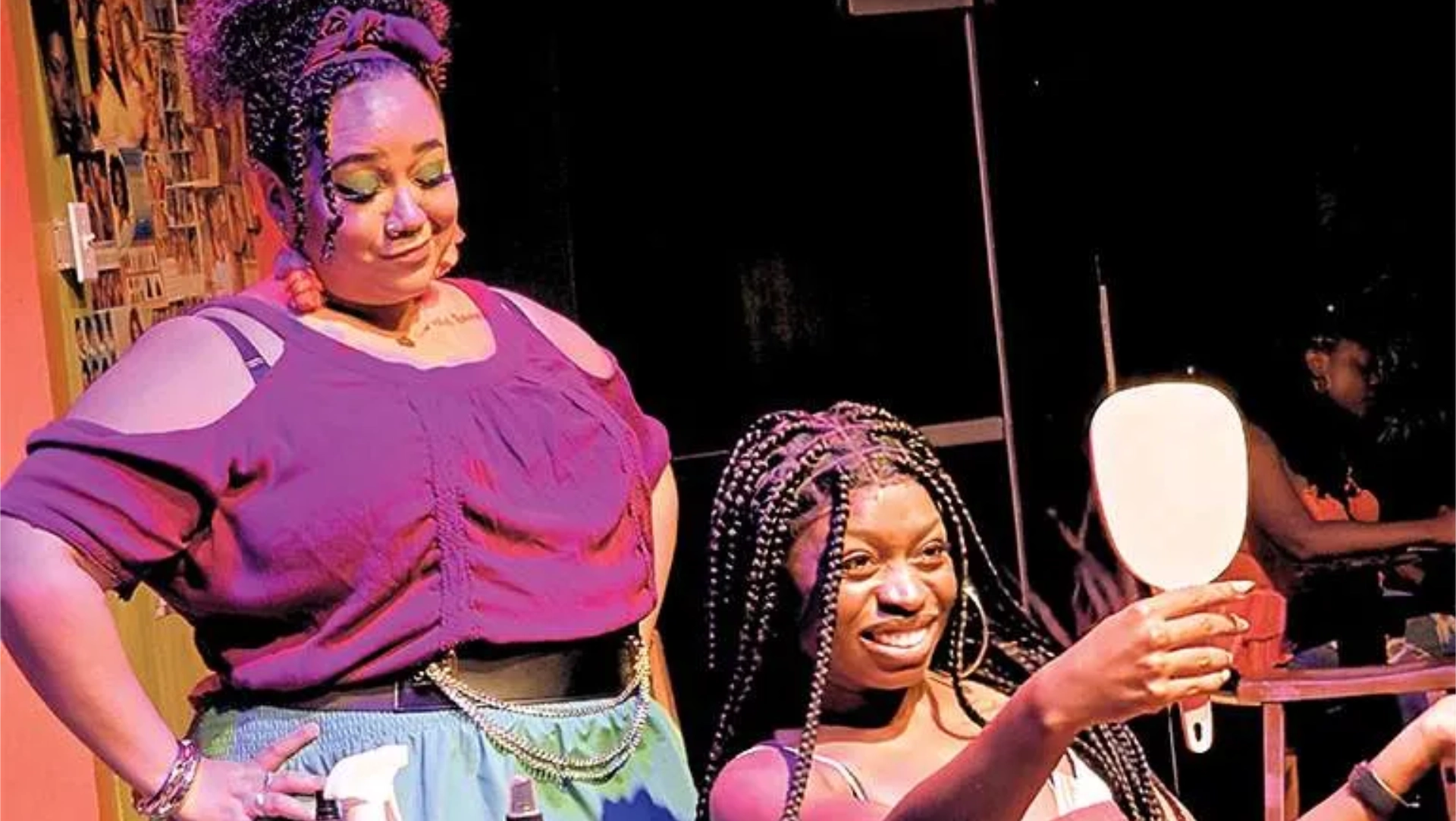
Yet playwright Jocelyn Bioh in her 2023 drama, Jaja’s African Hair Braiding, set on the corner of 125th, had me considering whether Bioh would rather call her Harlem — or at least this salon — Little Africa. The vibe and culture of Jaja’s in Three Bone Theatre’s outstanding QC premiere at The Arts Factory, where it runs through Nov. 24, had me feeling that I was in another country while it was unmistakably my
Staffed and patronized by locals who hail from Senegal, Gh
Jaja’s daughter Marie, a brilliant bundle of chaotic energy, is running the salon today because Mom is getting married later this afternoon to an unpopular landlord who will provide her and Marie with the shelter of citizenship. That will free Marie, a valedictorian at her high school using a borrowed identity, to apply to an Ivy League school worthy of her energy, talent and potential.
From the deluge of Marie’s opening monologue onwards, we realize that Jaja’s is a place bustling with life. Music is in the air, sometimes compelling the women to dance. There’s bickering, jealousy, hostility, vanity, teasing and earthy humor. Not a murderer or a rapist in sight among the immigrants. Not even a pet eater.
About the only oversight we can accuse director Donna Bradby of making is not helping us to observe Bioh’s signposts — via a wall clock and/or projections — of the time of day and the specified year this long, hot workday unfolds. Otherwise, Jennifer O’Kelly’s scenic d
A clock on the wall, for instance, would help us to appreciate how long young Jennifer, an aspiring reporter, is willing to sit at Miriam’s station in order for the patient artisan to outfit her with a full head of microbraids. And how long does the bossy, rude Vanessa fall asleep at Aminata’s stand before waking to her new look?
The visible excellence of Bradby’s cast is matched by the variety of Deborah Whitaker’s pre-, post-, and mid-weave hair designs. When blackouts happen between scenes, stage manager Megan Hirschy must have a huge chore in the small Arts Factory space helping the scurrying players reappear with the right hair when the lights come back up. We never just sit there tapping our feet during transitions; they’re almost lightning-quick.
Nor does it trouble Bradby that it’s impossible to keep track of who’s from Senegal, Ghana, or Sierra Leone. Venecia Boone was
Of Ghanaian descent and native to nearby Washington Heights, Bioh obviously knows he
Like Marie and the braiders, we will wait a long time before Myneesha King appears as Jaja — in wedding white, of course, with a queenly crown of braids — and delivers the most powerful monologue of all.
Meanwhile, it’s Valerie Thames as Bea, the most fashionable and contentious of Jaja’s employees, who fuels the liveliest action, seemingly able to hatch a new grudge at the drop of a spray bottle. The salon was her idea, not Jaja’s … Should have been a full partner in the biz … Refugee newcomer Ndidi is stealing her customers because her customers couldn’t possibly be dropping her … etc.
Thames seethes, fumes and makes scenes with a steely righteous dignity that sets us up for the turnabout that reveals her deep-down goodness and sense of community.
Until then, the human warmth of the shop emanates from Kellie Williams as Miriam and Vanessa Robinson as Aminata. Williams, rightly stationed upstage at the Arts Factory black box, is mostly distanced from the main sparring during her morning-to-night transformation of Jennifer’s tresses.
But there’s a distant man on Miriam’s mind throughout her labors, and she’s spending enough time in Jennifer’s hair to become quite chummy with the 18-year-old by evening’s end.
While her bestie and gossip buddy Bea seethes and sneers, Robinson mostly effervesces as Aminata. She knows that she doesn’t have the patience for a daylong immersion in microbraiding, so she’ll have none of Jennifer despite her youthful sunniness
But EJ Williams as Vanessa riles her almost to the point of losing her cool, a comical series of shticks that begins with the pushy customer objecting to house rules that requir
Aminata’s man troubles are nearer-to-hand than Miriam’s, for her wayward ne’er-do-well husband James only circles back to the nest to take advantage of her. Righteously divorced, Bea insists that Aminata drop this loser, dismissing the love factor that keeps her from following through with her resolve. Can’t help it when Graham Williams as James drops by and pushes his wife’s buttons.
So these skirmishes between Thames and Robinson — before and after James’ invasion — are the most delicious that we witness. Aside from her Dreamer worries, Brinson as Marie is occasionally thrust into the middle of disputes, laying down the law for the prissy Vanessa and stepping into the middle of Bea’s various tussles with Ndidi, Aminata and her defecting customer, Michelle. At one point, Marie even exiles the incorrigible Bea to the street!
The younger folk are calmer and more acclimated to post-truth America than their diva elders. Before we know it, Aminata is asking Marie how to tune the smart TV to YouTube.
Sarah Oguntomilade as Ndidi, the highest-grossing braider in the shop, is especially cool — thoughtfully equipped by Bioh with headphones and loud music to tune out Bea’s accusations and tirades.
There’s a really nice interlude when Graham fawns
Graham’s most impactful role is as Eric, the DVD man, who serves as the caring eyes and ears of the community. But it would be cruel to divulge any more.
Things happen quickly at Jaja’s. Notwithstanding the oppressive summer heat, each new character changes the temperature in the shop. Less obtrusively than Graham, Germôna Sharp brings in a variety of flavors as three different customers.
The most dramatic of these is the diffident Michelle, who thought she would be switching to Ndidi when Bea wasn’t there. Most comical is Sharp as Chrissy, wanting braids that will make her look like Beyoncé.
As if.
Guess Who's Coming to Dinner
Written by: Nancy Sasso Janis, Neighbor
Original Article can be found at: https://patch.com/connecticut/danbury/theater-review-guess-whos-coming-dinner-wcsu
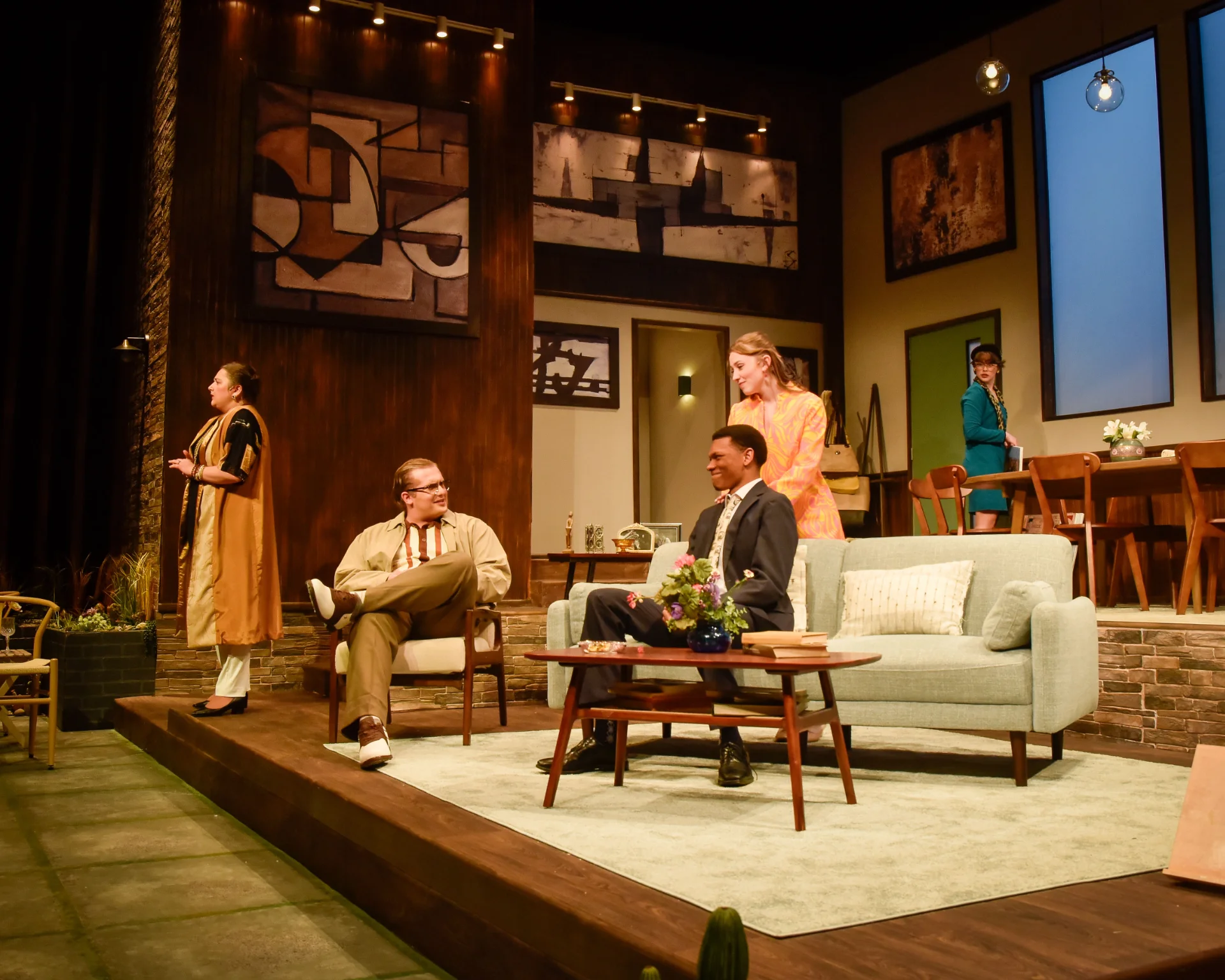
The students at Western CT State University took on the play “Guess Who's Coming to Dinner.” The two-act play written by Todd Kreidler ran two weekends at the Visual and Performing Arts Center at WCSU.
The play is based on the 1967 movie of the same name. The WCSU Theater Department explains that in it, “a progressive white couple's proud liberal sensibilities are put to the test when their daughter Hillary brings home her black fiance to meet them.” Matt and Christina Drayton “are blindsided by their daughter's whirlwind romance and fearful for her future, as they quickly come to realize the difference between supporting a mixed-race couple in your newspaper and welcoming one into your family -- especially in 1967.”
In the Dramaturg's Note in the printed program, Co-Dramaturg Donovan L. Shaw reminds us that when the film version premiered in 1967, it “confronted America's self-image as a progressive society. The Sidney Portier/Katharine Hepburn/Spencer Tracy film dared audiences to consider–within the context of a love story–where their personal beliefs aligned with their political ideals, asking if it is possible to be progressive in ideology but prejudiced in practice.” Shaw goes on to draw parallels to contemporary issues. “The tools of oppression may have shifted, but the battle remains.”
The co-dramaturg correctly points out that the story remains a love story at its heart, but stresses that the play is not a period piece. I would argue that as it was presented on the VPAC stage, it was hard to see it as anything but a period piece, albeit with a message that can be applied to the politics of today. I enjoyed it as an accurate representation of the race relations that I remember when I was a child, much of which unfortunately remains in our current climate.
Donna Baldwin-Bradby, a professor of Theatre Arts at North Carolina A&T University, directed the students, no doubt helping with the norms of the sixties. Leah Pallis worked as the assistant director.
The cast worked hard to bring this story to life, with strongly drawn characters that make up the two families. It is usually easy to ignore the fact that all of the performers are college-aged and must often play characters that are much older. This play required a further suspension of disbelief to accept that Dr. Prentice is a decade older than Joanna Drayton and the four parents are of an older generation.
Justin Villard, a senior BFA Acting major from Stamford, did his best to play the young black widower working in research, Dr. John Prentice. WCSU junior Jessica Ragucci portrayed the bubbly Joanna (“Joey”) as a young woman fiercely in love.
Samuel Rundell tackled the Spencer Tracy role of newspaperman Matt Drayton in his WCSU debut, with Caroline Benzi, a sophomore from Westbrook, as his wife Christina, played in the film by Katharine Hepburn.
Larry Williams, a sophomore from Bridgeport who has worked with Elm Shakespeare Company, took on the role of John Prentice, Sr. and did well. Blessett Anderson, a WCSU junior from Waterbury, stood out in the role of John's mother Mary.
WCSU junior Brianna Wright had some great lines in her role as the long-time maid Matilda “Tillly” Binks, a black woman who does not approve of the interracial match.
In the supporting role of Hilary St. George, the woman who runs Christina's art gallery, was Julia Crowley, a sophomore from Southington. Benjamin Goffredo, a first year BFA Musical Theatre major from Massachusetts, played family friend Monsignor Ryan.
Justin P. Cowan served as the show's producer, with Savannah Mantone as the production stage manager. Kori Hansen worked as the technical coordinator, with Tom Swetz as technical director. The scenic design by Danielle DeLaFuente blew me away with its feel for the sixties and how it allowed the characters to easily inhabit the upscale home. The design of the furniture brought back memories for me, as did the costumes designed by Joni Johns Lerner. Cheyenne Sykes designed the fine lighting and Ben Warner was in charge of sound design. I missed a few of the lines now and then because I was seated in an area on one side of the venue.
The students at Western CT State University took on the play “Guess Who's Coming to Dinner.” The two-act play written by Todd Kreidler ran two weekends at the Visual and Performing Arts Center at WCSU.
The play is based on the 1967 movie of the same name. The WCSU Theater Department explains that in it, “a progressive white couple's proud liberal sensibilities are put to the test when their daughter Hillary brings home her black fiance to meet them.” Matt and Christina Drayton “are blindsided by their daughter's whirlwind romance and fearful for her future, as they quickly come to realize the difference between supporting a mixed-race couple in your newspaper and welcoming one into your family -- especially in 1967.”
In the Dramaturg's Note in the printed program, Co-Dramaturg Donovan L. Shaw reminds us that when the film version premiered in 1967, it “confronted America's self-image as a progressive society. The Sidney Portier/Katharine Hepburn/Spencer Tracy film dared audiences to consider–within the context of a love story–where their personal beliefs aligned with their political ideals, asking if it is possible to be progressive in ideology but prejudiced in practice.” Shaw goes on to draw parallels to contemporary issues. “The tools of oppression may have shifted, but the battle remains.”
The co-dramaturg correctly points out that the story remains a love story at its heart, but stresses that the play is not a period piece. I would argue that as it was presented on the VPAC stage, it was hard to see it as anything but a period piece, albeit with a message that can be applied to the politics of today. I enjoyed it as an accurate representation of the race relations that I remember when I was a child, much of which unfortunately remains in our current climate.
Donna Baldwin-Bradby, a professor of Theatre Arts at North Carolina A&T University, directed the students, no doubt helping with the norms of the sixties. Leah Pallis worked as the assistant director.
The cast worked hard to bring this story to life, with strongly drawn characters that make up the two families. It is usually easy to ignore the fact that all of the performers are college-aged and must often play characters that are much older. This play required a further suspension of disbelief to accept that Dr. Prentice is a decade older than Joanna Drayton and the four parents are of an older generation.
Justin Villard, a senior BFA Acting major from Stamford, did his best to play the young black widower working in research, Dr. John Prentice. WCSU junior Jessica Ragucci portrayed the bubbly Joanna (“Joey”) as a young woman fiercely in love.
Samuel Rundell tackled the Spencer Tracy role of newspaperman Matt Drayton in his WCSU debut, with Caroline Benzi, a sophomore from Westbrook, as his wife Christina, played in the film by Katharine Hepburn.
Larry Williams, a sophomore from Bridgeport who has worked with Elm Shakespeare Company, took on the role of John Prentice, Sr. and did well. Blessett Anderson, a WCSU junior from Waterbury, stood out in the role of John's mother Mary.
WCSU junior Brianna Wright had some great lines in her role as the long-time maid Matilda “Tillly” Binks, a black woman who does not approve of the interracial match.
In the supporting role of Hilary St. George, the woman who runs Christina's art gallery, was Julia Crowley, a sophomore from Southington. Benjamin Goffredo, a first year BFA Musical Theatre major from Massachusetts, played family friend Monsignor Ryan.
Justin P. Cowan served as the show's producer, with Savannah Mantone as the production stage manager. Kori Hansen worked as the technical coordinator, with Tom Swetz as technical director. The scenic design by Danielle DeLaFuente blew me away with its feel for the sixties and how it allowed the characters to easily inhabit the upscale home. The design of the furniture brought back memories for me, as did the costumes designed by Joni Johns Lerner. Cheyenne Sykes designed the fine lighting and Ben Warner was in charge of sound design. I missed a few of the lines now and then because I was seated in an area on one side of the venue.